Why Harmonic Reduction Gear Is Central to Humanoid Robot Joint Design
Explore why harmonic reduction gears are essential for humanoid robot joints. Learn about high torque density and precision in robotic actuator design.
 March 04, 2026
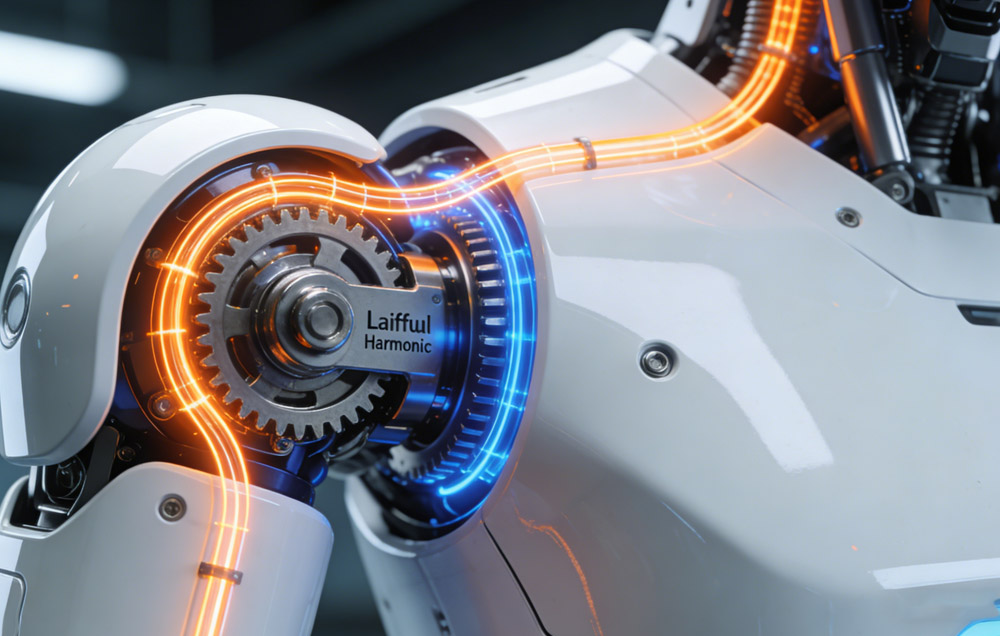

Humanoid robots are entering a phase where motion quality, stability, and adaptability are becoming decisive factors in real-world deployment.
Unlike traditional industrial robots, humanoid robots must operate in unstructured environments, interact with humans, and perform tasks that demand both strength and delicacy. At the center of these capabilities lies joint technology.
Harmonic reduction gear has emerged as a preferred solution for humanoid robot joints, offering a balance of precision, compact structure, and controllable motion that aligns with the evolving demands of embodied intelligence.
Why Joint Technology Defines Humanoid Robot Capability
A humanoid robot typically integrates dozens of joints across fingers, wrists, elbows, shoulders, waist, and legs. Each joint must manage torque transmission, positioning accuracy, and dynamic response within a limited space and weight envelope.
Inconsistent joint behavior directly affects balance control, manipulation accuracy, and motion coordination. For this reason, joint performance is no longer evaluated only by torque ratings or reduction ratios, but by how reliably mechanical motion aligns with control algorithms and sensory feedback.
Harmonic reduction gear supports this requirement by delivering stable motion behavior with minimal backlash, allowing joint commands to translate into predictable physical movement.
Precision as the Basis for Embodied Intelligence
Humanoid robots rely on continuous feedback loops that combine perception, computation, and execution. Vision systems, force sensors, and tactile inputs generate high resolution data, but this data only becomes useful when joints can respond with proportional and repeatable motion.
Harmonic reduction gear enables this interaction by maintaining consistent positioning accuracy under changing load conditions. When joint deviation remains within tight limits, control systems can refine motion strategies in real time, supporting balance correction, adaptive grasping, and coordinated whole body movement.
This mechanical predictability allows humanoid robots to perform tasks that require subtle force control, such as holding fragile objects or interacting safely with humans.
Compact Structure Supporting High Degree of Freedom
Humanoid robots demand a high degree of freedom while maintaining a human-like form factor. Joint assemblies must remain compact without sacrificing torque capacity or durability.
Harmonic reduction gear offers a high reduction ratio within a small volume, making it suitable for densely packed joint designs. This characteristic supports slim limb profiles and lightweight structures, which are important for energy efficiency and natural motion patterns.
In finger and wrist joints, compact harmonic reducers allow fine motor control. In larger joints such as hips and waist, they support stable load handling while preserving smooth motion during walking and turning.
Stability Under Dynamic and Repetitive Motion
Humanoid robots operate under continuous motion rather than repetitive point-to-point cycles. Walking, grasping, and interacting with objects introduce dynamic loads and frequent direction changes.
Harmonic reduction gear maintains transmission stability under these conditions by distributing load across multiple teeth and supporting smooth torque output. This stability reduces motion fluctuation and supports consistent joint response throughout extended operation.
As a result, humanoid robots can sustain longer duty cycles without performance drift, supporting practical deployment beyond laboratory environments.
From Component Advantage to System Level Integration
The value of harmonic reduction gear in humanoid robots extends beyond individual components. As joint modules increasingly integrate reducers, motors, encoders, and control electronics, harmonic reduction gear provides a mechanical foundation that aligns with system level design.
Stable transmission behavior simplifies control tuning, reduces compensation requirements, and supports faster system integration. This alignment between mechanical design and control architecture strengthens the overall competitiveness of humanoid robot platforms.
Looking Ahead in Humanoid Robot Development
As humanoid robots progress toward broader commercial and service applications, joint technology will continue to shape their functional boundaries. Harmonic reduction gear is positioned to support this evolution by enabling precise, compact, and adaptable joint motion.
By bridging mechanical stability and intelligent control, the harmonic reduction gear secures a lasting advantage in humanoid robot joint technology and contributes to the advancement of embodied robotics.